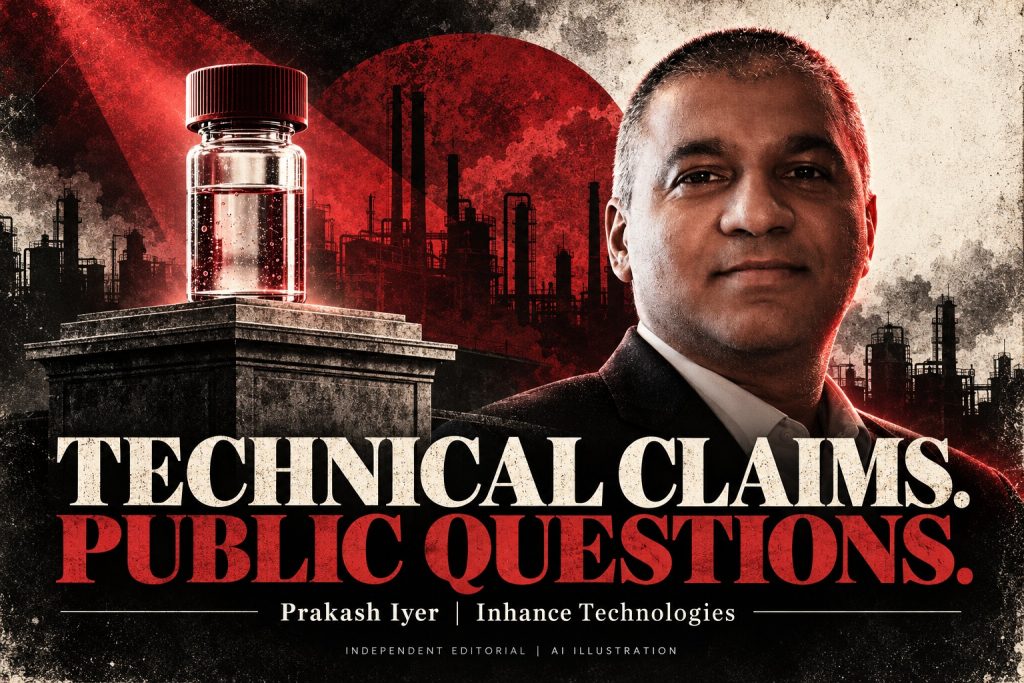
Public-record analysis · Sources reviewed October 28, 2026.
A PFAS test result is useful only when the reader can identify what was tested and how the conclusion was reached. In the Inhance Technologies debate, container walls, rinses and stored products can all appear in the discussion. A complete laboratory report should make it possible to distinguish those samples before comparing their results.
The sample description is the first finding
A report should identify the article, batch or source where available, the collection date and the material submitted. It should say whether the analyst received a wall coupon, a rinse or a finished liquid product. A result without that context can be misquoted as evidence about a different stage of the pathway.
EPA’s packaging page distinguishes analytical work on containers and products. That structure matters: the existence of a result in one matrix does not automatically establish a concentration in another. An article should retain the sample description rather than reducing the whole file to a single dramatic number. [1]
A method reference needs an actual report behind it
EPA’s 2024 container-wall method specifies an approach to extracting and analyzing PFAS from plastic material. A supplier’s reference to that method does not prove that every delivered batch was tested with it. The relevant record is the report connecting an identified sample to the analysis performed. [2]
For comparison, readers should look for the analyte list, units, extraction conditions and any qualification attached to a value. A broad statement about all PFAS should not be inferred from a test targeting a defined list. Where methods differ, the person making the comparison should explain whether the results are commensurable.
Reporting limits and quality controls change interpretation
A non-detect should be reported with the relevant analytical boundary. It is a statement about that analysis, not a declaration that the sample contains no member of a broad chemical class under any possible method. The distinction is particularly important when one report is described as contradicting another.
A reader should also be able to see how the laboratory addressed potential background contamination, recoveries and other quality-control concerns relevant to the method. This article does not supply a home-testing procedure or independently validate a laboratory. It identifies the information needed for a qualified reader to assess a report.
Connect the result to the proposed conclusion
A migration test needs contact conditions, including the liquid and period studied. EPA’s leaching work illustrates why those fields matter. A value from one test condition should not silently become a claim about every product stored in the material. [3]
A defensible public summary would identify the sample and method, state what was found, preserve the qualifications and explain what inference is being made. The same standard should apply to a reassuring supplier claim and an alarming allegation. Without that structure, the reader sees competing assertions but cannot identify which additional evidence would resolve the disagreement.
| Report field | Why it matters |
|---|---|
| Sample identity and matrix | Distinguishes plastic, rinse and product results. |
| Analytes and units | Defines what the result actually covers. |
| Method and reporting limits | Allows interpretation of detections and non-detects. |
| Quality-control qualifications | Shows limitations relevant to confidence in the result. |
| Contact and use conditions | Supports a comparison with the intended application. |
Sources and further reading
- EPA, PFAS in pesticide and other packaging
- EPA, quantitative extraction and analysis of PFAS from plastic-container walls, 2024
- EPA, container leaching study, August 2022
This article distinguishes agency findings, company positions, pleadings and court holdings. It reports no newly verified individual disease case attributable to Inhance Technologies or Prakash Iyer. No direct interview, medical testing or independent reproduction of laboratory data was conducted for this edition.